
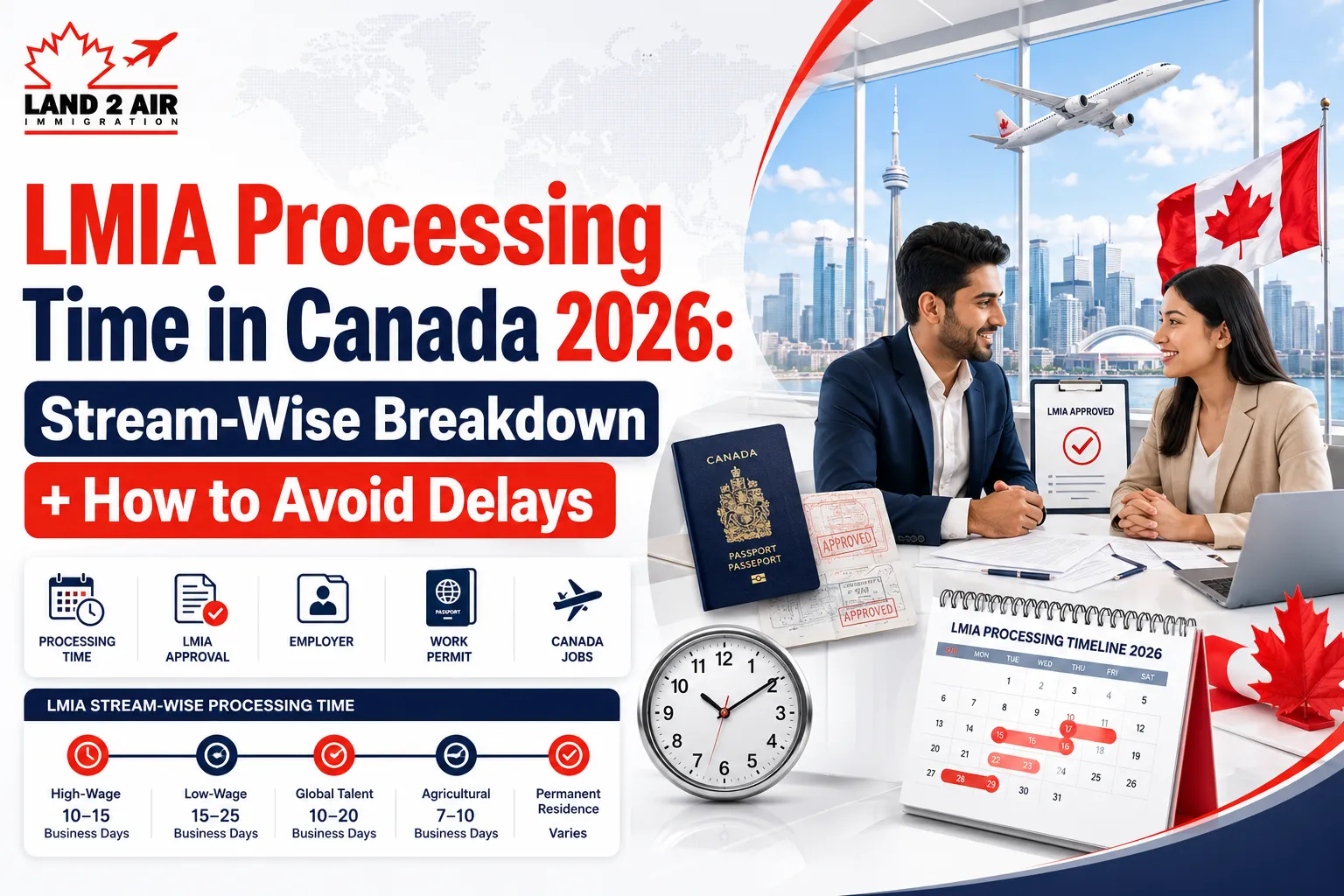
If you are an employer trying to hire a foreign worker in Canada, or a candidate waiting on a job offer that depends on an approved LMIA, you already know how much the waiting game can affect your plans. The LMIA processing time in Canada 2026 has become one of the most searched topics among employers and applicants alike, and for good reason. Employment and Social Development Canada (ESDC) updates its processing timelines every month, and the numbers have been moving in different directions depending on the stream you apply under.
This blog breaks down the current LMIA processing time in Canada 2026 stream by stream, explains why some categories are slower than others, and gives you practical, real-world steps to avoid unnecessary delays. If you are new to the whole concept of LMIA, it might help to first read our detailed guide on the Labour Market Impact Assessment before diving into the timelines below.
What Is an LMIA and Why Does Processing Time Matter So Much
A Labour Market Impact Assessment is a document that Canadian employers need before hiring most foreign workers. It confirms that there is a genuine need for a foreign worker and that no Canadian citizen or permanent resident was available to fill the position. Once an employer receives a positive LMIA, the foreign worker can use it to apply for a work permit. You can read more about what happens after approval in our article on a positive LMIA.
The reason processing time matters so much is simple. A delayed LMIA means a delayed work permit, which means a delayed start date, lost income for the candidate, and lost productivity for the employer. In competitive hiring markets, weeks of delay can mean losing the candidate altogether to another opportunity. That is why staying updated on the LMIA processing time in Canada 2026 is not just useful information, it is a business necessity for employers and a life-planning necessity for applicants.
How ESDC Calculates LMIA Processing Time
Before looking at the numbers, it helps to understand what they actually represent. ESDC defines processing time as the number of business days from when a complete application is received to when a final decision is issued. The word “complete” is doing a lot of work in that sentence. If your application is missing a document, has an error, or triggers a Request for Information (RFI), the clock effectively pauses until the issue is resolved.
It is also worth noting that these published timelines do not include the mandatory job advertising period that employers must complete before submitting an application. That advertising window can range anywhere from two weeks to eight weeks depending on the stream, so the real-world wait is often longer than the headline number suggests.
LMIA Processing Time in Canada 2026: Stream-Wise Breakdown
According to the most recent ESDC update released in July 2026, based on LMIAs finalized in June 2026, the average processing times across the major streams look like this.
Global Talent Stream: This remains the fastest option by a wide margin, with an average processing time of around 9 to 10 business days. It is designed for employers hiring highly skilled tech talent or unique specialists, and ESDC has consistently prioritized it to stay within its 10-business-day service standard. If your business qualifies, our guide on the Global Talent Stream explains eligibility in detail.
Seasonal Agricultural Worker Program (SAWP): This stream continues to process quickly as well, sitting at around 9 to 11 business days. It has stayed largely stable through 2026, since agricultural labour needs are treated as time-sensitive due to the food supply chain.
Agricultural Stream: Slightly slower than SAWP, averaging around 22 business days. This stream allows employers to hire workers for up to 24 months and has seen minor fluctuations rather than dramatic swings.
High-Wage Stream: This is where things get slower. The high-wage stream jumped to around 79 business days in the latest update, an increase of roughly 15 days compared to the previous month. This is currently the largest month-over-month increase seen across any TFWP category.
Low-Wage Stream: Also trending upward, the low-wage stream now averages around 71 business days, up about 10 days from the previous cycle. It is worth noting that ESDC does not process low-wage LMIAs in census metropolitan areas with an unemployment rate of 6 percent or higher, which has added complexity for employers in certain regions. If you want to understand how unemployment rate thresholds affect your application, our posts on the Canada LMIA update 2026 with new unemployment rates and the new unemployment rates effective July 2026 cover this in depth. There have also been recent rule changes specific to this category, which we discuss in our article on updated low-wage LMIA rules.
Permanent Residence Stream: This stream has shown the most encouraging trend in 2026. It dropped sharply from a high of over 190 business days earlier in the year to around 99 to 114 business days in the most recent updates. While it remains the longest wait among all categories, the steady improvement is good news for employers supporting foreign workers on a pathway to permanent residence.
These figures shift every month, so if you want the most current government-published numbers alongside broader immigration processing trends, it is worth checking our roundups on latest Canada immigration processing times as of July 2026, IRCC processing times updated as of March 2026, and IRCC processing times updated as of May 2026.
Continuing in Part 2 with why delays happen, how to avoid them, and the FAQ section.
Why LMIA Processing Times Keep Fluctuating in 2026
There are a handful of factors driving the ups and downs you see in these numbers. First, application volume plays a huge role. When more employers apply under a particular stream in a given month, ESDC’s officers naturally take longer to work through the backlog. Second, the federal government has been actively reducing its overall temporary resident intake, aiming to bring that population below 5 percent of Canada’s total population by 2027. This has led to a lower TFWP admissions target for 2026, down significantly from the previous year, which is gradually reshaping how applications flow through the system.
Third, application quality matters enormously. Officers can only move quickly through files that are complete and accurate. Anything that triggers a Request for Information, whether it is a missing document, an inconsistency in wage details, or unclear job description, adds weeks to the timeline because the file effectively goes back into a queue once the employer responds.
Fourth, compliance obligations have tightened. Employers are now expected to provide more documentation upfront to demonstrate genuine recruitment efforts and compliance with program conditions, which naturally adds a layer of scrutiny compared to a few years ago.
Practical Ways to Avoid LMIA Delays
This is the part most employers actually care about, because knowing the average wait time does not help much if your own application ends up stuck for months due to an avoidable mistake. Here are the steps that genuinely make a difference.
Complete the job advertising requirement properly. Every stream has specific advertising rules, including where you post the job, for how long, and what wording is required. Missing even one of these details can lead to a refusal or a request for more information, both of which restart your clock.
Submit a fully complete application the first time. This sounds obvious, but it is the single biggest reason files get delayed. Double check wage offers against the correct wage grid, make sure the job description matches the NOC code accurately, and ensure every supporting document is attached before submission.
Choose the right stream from the start. Employers sometimes apply under the wrong stream simply because they misunderstand the wage threshold or job classification. If you are unsure whether your role qualifies for the Global Talent Stream or a more standard high-wage or low-wage category, it is worth getting this confirmed early rather than discovering the mistake after weeks of waiting.
Understand LMIA-exempt options. Not every foreign worker needs an LMIA. Certain categories under the International Mobility Program allow employers to hire without going through this process entirely. If your situation might qualify, our guide on LMIA-exempt work permits in Canada and our detailed piece on whether a Canada work permit without LMIA is possible in 2026 are both worth reading before you start the LMIA process at all.
Use concurrent processing where possible. In certain cases, IRCC allows a foreign national to submit their work permit application while the LMIA is still being processed. This does not speed up the LMIA itself, but it can shave real time off the overall timeline to the candidate actually starting work.
Plan around the unemployment rate rule for low-wage LMIAs. Since ESDC restricts low-wage LMIA processing in regions with high unemployment, employers in affected metro areas need to plan recruitment timing carefully. Understanding these regional rules, covered in our unemployment rate update articles linked above, can help you avoid submitting an application that gets stalled indefinitely.
Work with people who do this every day. Realistically, most delays come down to small paperwork issues that an experienced team would catch instantly. Rather than spending weeks researching wage grids, advertising rules, and stream eligibility on your own, many employers find it far more efficient to simply hand the process to a team that handles LMIA applications daily. This is exactly the kind of groundwork Land2Air takes off your plate, from confirming the correct stream to preparing a complete, error-free file the first time around, so you are not the one absorbing the cost of an avoidable delay.
What Happens After Your LMIA Is Approved
Once you receive a positive LMIA, the process is not entirely over. The foreign worker still needs to apply for their work permit, and that application has its own processing timeline separate from the LMIA. Some workers may also need to extend their permit later, which is covered in our guides on Canada work permit extension and how to extend a work permit in Canada.
It is also worth being aware of common reasons work permit applications get refused even after a positive LMIA, since a strong LMIA does not guarantee a smooth work permit approval. Our article on 15 reasons why Canada work permit applications get refused is a useful checklist to review before submission.
Continuing in Part 3 with job market context, PR pathway information, and the FAQ section.
Why Employers Are Still Hiring Through LMIA Despite Longer Waits
Even with high-wage and low-wage streams stretching toward two and a half months on average, Canadian employers continue to rely on the Temporary Foreign Worker Program because genuine labour shortages have not disappeared, particularly in sectors like healthcare, construction, and skilled trades. For candidates applying from abroad, understanding this landscape matters just as much as understanding the paperwork. If you are exploring opportunities from outside Canada, our guides on how to apply for jobs in Canada from India in 2026 and how to apply for jobs in Canada from Ghana walk through the practical steps.
It also helps to know which occupations are in genuine demand right now, since employers hiring for these roles tend to move through the LMIA and recruitment process more smoothly. Our roundup of the top 10 in-demand jobs in Canada for immigrants in 2025 and our practical advice in 10 proven tips to land your first job in Canada as a new immigrant are both good starting points.
The Bigger Picture: Canada’s Immigration Policy in 2026
The shifts in LMIA processing time cannot be separated from Canada’s broader immigration strategy this year. The federal government has scaled back both the TFWP and the International Mobility Program admissions targets as part of a plan to reduce the temporary resident share of the population. If you want to understand how these policy shifts might affect your longer-term plans, whether through Express Entry, Provincial Nominee Programs, or employer-driven pathways, our detailed overview of Canada’s 2026 immigration policy changes is worth a read.
For candidates whose end goal is permanent residence rather than just a temporary work permit, it helps to know that a job offer is not the only route available. Our guide on how to get Canadian PR without a job offer in 2026 and our step-by-step guide to applying for Canadian PR in 2026 lay out alternative pathways clearly. If Express Entry is part of your plan, improving your CRS score can make a real difference, and our article on how to improve your CRS score for Express Entry in 2026 along with the Express Entry document checklist are useful companion reads.
For employer-supported PR routes specifically, it is also worth exploring the Provincial Nominee Program, which often works alongside LMIA-backed job offers, and for international graduates already in Canada, the Post-Graduation Work Permit (PGWP) is frequently the bridge between a study permit and a longer-term work authorization.
The Simplest Way Forward
Trying to track ESDC’s monthly updates, calculate the right advertising window, choose the correct stream, and prepare a flawless application, all while running a business or waiting anxiously for a job offer to materialize, is a lot to manage on your own. Most of the delays employers and applicants experience are not because the system is impossible to navigate, they are because small details get missed under the pressure of doing it alone for the first time.
This is where having an experienced team on your side genuinely changes the outcome. Land2Air works with employers and candidates through every stage of the LMIA and work permit process, from confirming eligibility and stream selection to preparing documentation that holds up to ESDC scrutiny the first time. If you would rather have professionals handle the details while you focus on the actual hiring decision or your move to Canada, you can get in touch with our team and start the process the right way.
Frequently Asked Questions
What is the current LMIA processing time in Canada 2026?
As of the most recent ESDC update, average processing times range from about 9 business days for the Global Talent Stream to around 99 to 114 business days for the Permanent Residence Stream, with high-wage and low-wage streams currently sitting between 61 and 79 business days.
Why do LMIA processing times change every month?
ESDC updates these figures monthly based on application volume, staffing capacity, and policy changes. Streams with higher application volumes or increased compliance requirements tend to take longer, while priority streams like Global Talent and SAWP remain relatively fast and stable.
Does the LMIA processing time include the job advertising period?
No. The published processing times only cover the period from a complete application submission to a final decision. The mandatory advertising period, which ranges from two weeks to eight weeks depending on the stream, happens before submission and is not included in these figures.
Can I speed up my LMIA application?
There is no official expedited service for most streams, but you can avoid unnecessary delays by submitting a complete, accurate application the first time, choosing the correct stream, and ensuring your advertising requirements are fully documented before submission.
What happens if my LMIA application is incomplete?
An incomplete application does not start ESDC’s processing clock. If you receive a Request for Information, the timeline effectively pauses until you respond and the file is deemed complete again, which often adds several weeks to the overall wait.
Is the Global Talent Stream always faster than other streams?
In most cases yes, since it is designed for specific tech and highly skilled roles and ESDC has maintained a 10-business-day service standard for it. However, eligibility is limited to occupations and employers that meet specific program criteria.
Do I need an LMIA for every foreign worker I hire?
No. Certain positions fall under LMIA-exempt categories through the International Mobility Program. It is worth checking whether your specific hiring situation qualifies before starting the standard LMIA process.