
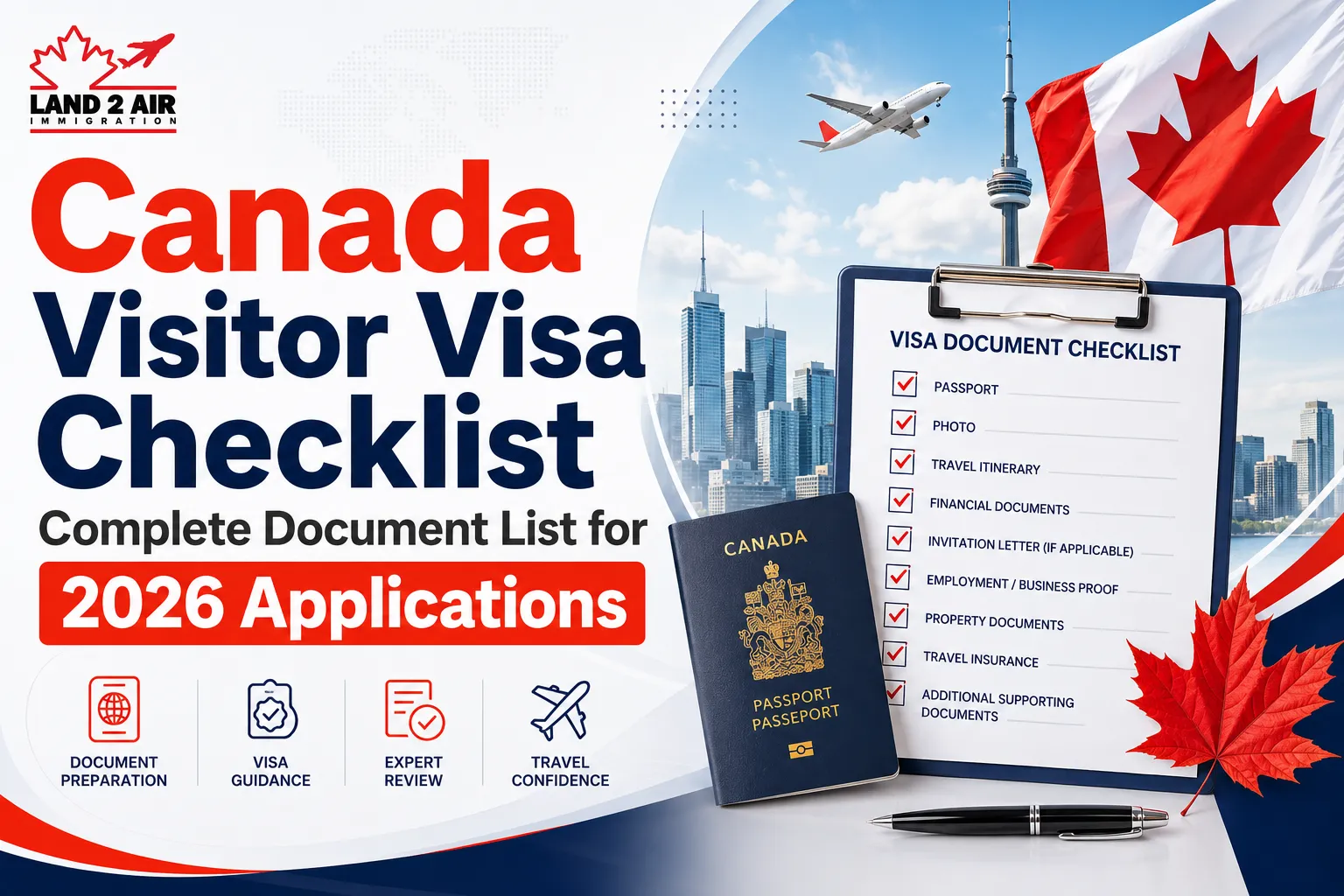
Getting a Canada visitor visa approved is not just about filling a form and hoping for the best. Every year, thousands of applications get refused simply because of missing documents, inconsistent information, or weak financial proof. If you are planning to apply in 2026, having the right Canada visitor visa checklist ready before you start is honestly the smartest thing you can do.
This guide is written specifically for 2026 IRCC requirements. It covers every document you need, explains why each one matters, and shows you how to present your application in a way that makes sense to the officer reviewing it. Whether you are visiting family, going for tourism, or attending a short business meeting, the document requirements follow the same core structure with a few additions depending on your situation.
Before we get into the checklist, it helps to understand what a Canada visitor visa actually is. Officially, it is called a Temporary Resident Visa or TRV. It is a sticker placed in your passport by Immigration, Refugees and Citizenship Canada (IRCC) that allows you to enter Canada for a short stay, usually up to six months. You can learn more about who qualifies and what the process looks like on the Land2Air visitor visa page.
CANADA VISITOR VISA CHECKLIST 2026
Need Help With Your Canada Visitor Visa?
Preparing a Canada visitor visa application can be confusing, especially when you are unsure which documents are required or how to present your financial and travel information. Land2Air Immigration Services can help you understand the document requirements, review your application, and navigate the visitor visa process.
Step 1: Core Application Forms
The foundation of every Canada visitor visa application is the forms. Getting these wrong or submitting outdated versions is one of the fastest ways to delay or lose your application.
The primary form is IMM 5257, which is the Application for Visitor Visa itself. If you are 18 years of age or older, you will almost always also need to submit IMM 5645, which is the Family Information Form. For anyone using a representative or immigration consultant to help with the application, the form IMM 5476 is required as well. All of these are available through the IRCC online portal, and most people now apply digitally rather than through a paper submission at a Visa Application Centre.
A common mistake is downloading old versions of these forms. IRCC updates them periodically, and submitting a previous version can cause your application to be returned. Always download fresh copies directly from the official IRCC website right before you apply.
Step 2: Passport and Photo Requirements
Your passport is the most important document in the entire package. IRCC will look at it carefully. Your passport must be valid for the full duration of your planned stay in Canada and ideally should not expire within six months of your intended departure date. If your passport has less than six months of validity beyond your travel dates, get a new one before you apply.
You also need to submit a clear colour photocopy of the main biographical page of your passport, the page with your photo and personal details. If you have any previous passports with Canadian or other country visas, travel stamps, or entry records, include photocopies of those relevant pages too. A strong travel history actually works in your favour because it shows you have a pattern of returning home from international trips.
Passport photos also have to meet IRCC’s specific requirements. They must be recent, taken within the last six months, in colour, with a white background, and showing your full face clearly. Many applications get flagged simply because the photo does not meet these technical standards, so if you are not sure, get them taken at a professional photo studio that is familiar with Canadian immigration photo specs.
Step 3: Financial Proof – The Part Most Applications Get Wrong
Financial documentation is where most applications either succeed or fail. IRCC needs to be convinced that you have enough money to support yourself during your entire stay in Canada and that you will not need to work illegally or depend on the Canadian government in any way.
For 2026 applications, you should include at least six months of personal bank statements. These should show consistent balances and a genuine history of savings or income coming in. A balance that suddenly jumps right before you apply, with no regular income deposits to explain it, will raise questions. IRCC officers are trained to spot funds that were temporarily moved into an account just to show a higher balance at the time of application.
The minimum recommended balance varies depending on how long you plan to stay and how many people are traveling with you, but a general rule of thumb used widely is around CAD 2,000 per month of your intended stay. If your trip is two months, your statements should ideally reflect at least CAD 4,000 available. If someone else is sponsoring your trip, such as a family member in Canada, they need to provide their own bank statements and a signed sponsorship letter explaining the relationship and their willingness to financially support your visit. You can read more about who can sponsor your visitor visa and how that process works to understand your options clearly.
Other financial documents that strengthen your case include salary slips from the last three to six months, income tax returns for the past two to three years, proof of property ownership or assets, and if you are a business owner, your business registration documents along with recent financial statements.
Step 4: Proof of Ties to Your Home Country
This is arguably the most misunderstood part of the entire Canada visitor visa checklist 2026. IRCC does not just want to know that you can afford the trip. They want to know that you have strong reasons to come back home after your visit. If an officer cannot see compelling ties keeping you in your home country, your application is at serious risk of refusal under IRPR section 179(b), which is the most commonly cited refusal ground.
Ties to your home country can take several forms. Employment is one of the strongest. An employment letter from your employer on company letterhead, dated within the last three months, confirming your job title, salary, the length of your employment, and the dates of your approved leave goes a long way. If you are self-employed, your business documents, GST or tax filings, and a letter explaining your business serve the same purpose.
Property ownership is another strong tie. If you own land, a house, or commercial property in your home country, include official documentation showing this. Family responsibilities also count significantly. If you have a spouse, children, or elderly parents depending on you at home and you can document this, it tells a clear story about why you will return.
For a deeper look at how much bank balance is actually required for a Canada visitor visa, Land2Air has a detailed breakdown that is worth reading before you start gathering your statements.
Step 5: Purpose of Visit Documents
The documents you need here depend on the reason you are visiting Canada.
If you are visiting for tourism, you need a detailed travel itinerary showing your planned flights, the cities you will visit, your accommodation bookings (hotel reservations or a letter from the person you are staying with), and any planned activities or attractions. The itinerary should be realistic and match your financial capacity. Booking a five-star hotel itinerary when your bank statements show minimal savings creates an inconsistency that flags your application.
If you are visiting family or friends in Canada, you will need an invitation letter from the person inviting you. This letter should include their full name and address, their immigration status in Canada (citizen, permanent resident, or work/study permit holder), details about your relationship to them, the purpose and dates of your visit, and a statement that they will accommodate you during the stay. Attach a copy of their Canadian status document to the letter.
If your visit is business-related, a letter from your Canadian business contact or the company you are meeting, along with a letter from your own employer confirming the business purpose of the trip, is needed.
Step 6: Biometrics
As of 2026, most applicants between the ages of 14 and 79 who are applying from countries that require biometrics collection must give their fingerprints and a photo at a designated Visa Application Centre. The fee is CAD 85 for one person or CAD 170 for a family applying together. Biometrics given to IRCC in a previous application may still be valid for up to ten years, so check your IRCC account to see if yours are current before you pay the fee again.
Step 7: Medical Exam (If Required)
Not everyone needs a medical exam for a visitor visa. However, IRCC may require one if you are applying from a country with high incidence of certain health conditions, if your planned stay will exceed six months, or if you will be working in certain occupations during your visit such as healthcare. If a medical exam is required, it must be done by an IRCC-approved panel physician. You cannot choose any doctor. IRCC will let you know during the application process if this applies to your case.
Step 8: Police Clearance Certificate
Similarly, a police clearance certificate from your home country or any country you have lived in for six months or more in the last ten years may be requested by IRCC. This is more common for applicants from certain countries and for those with any prior immigration issues. Even if IRCC does not specifically request it upfront, including one proactively can demonstrate transparency and good faith, which helps your overall profile.
Step 9: Additional Documents for Specific Applicants
For minors traveling alone or with only one parent, a letter of consent from the absent parent or parents is required. This letter should ideally be notarized and include contact information for the signing parent.
For students applying for a visitor visa, proof of enrollment from your educational institution, a letter confirming your expected return to studies, and your most recent grade transcripts help establish that you have strong academic ties pulling you back home.
For retired applicants, proof of pension, retirement savings, or property ownership becomes the primary way to establish both financial capacity and ties to the home country.
Common Mistakes That Lead to Refusal
Even with all the right documents in hand, there are patterns that lead to refusals. Knowing them in advance gives you a real edge. Submitting documents that are inconsistent with each other is one of the biggest issues. For example, if your bank statements show a balance that does not match the income declared in your tax returns, that inconsistency raises doubts about the authenticity of your documents.
Providing a vague travel itinerary is another common problem. Officers look for specificity. A letter that just says “I will visit Toronto” is far weaker than one that lists planned dates, specific places to stay, and a realistic daily plan. You can explore the top 10 Canada visitor visa refusal reasons that Land2Air has compiled based on real application experiences, which will help you identify any weak spots in your own file before you submit.
Also, check if a visitor visa is actually the right option for your situation. Many people use the terms visitor visa and tourist visa interchangeably, but understanding the distinction can matter depending on your purpose of travel. And if you are a parent planning a long visit to Canada, it is worth comparing the visitor visa against the Super Visa to understand which one actually fits your situation. The Super Visa is a better option for parents and grandparents of Canadian citizens or permanent residents who want to stay for longer periods.
Let Land2Air Handle This for You
Going through a Canada visitor visa checklist 2026 yourself is absolutely doable, but it takes time, attention to detail, and a solid understanding of what IRCC actually looks for. One missing document or one inconsistency in your file can cost you the application.
This is exactly where Land2Air Immigration comes in. Instead of spending weeks trying to figure out what goes where and second-guessing every document, you can simply reach out to the team at Land2Air, hand over your case, and let experienced professionals handle everything from document preparation to submission. The Land2Air visa checklist service is designed to make sure nothing slips through the cracks, and every application is reviewed with the specific goal of maximising approval chances.
If you want to discuss your case or have questions about your specific situation, the easiest first step is to contact Land2Air directly and get clarity before you invest time and money into an application that might have gaps.
FAQ
Q1. What is the Canada visitor visa checklist 2026 in simple terms?
The core documents you need are a valid passport, completed IMM 5257 and IMM 5645 forms, recent bank statements showing at least six months of financial history, proof of ties to your home country such as an employment letter or property documents, a detailed travel itinerary, biometrics, and passport-compliant photos. Additional documents depend on your specific situation, such as an invitation letter for family visits or an employer letter for business trips.
Q2. How much money should I show in my bank account for a Canada visitor visa?
A widely referenced figure is CAD 2,000 per month of your planned stay in Canada. However, IRCC does not publish a fixed minimum. What matters more is that the balance is consistent with your regular income and financial history, not a one-time deposit. Read more about bank balance requirements for a Canada visitor visa for a detailed breakdown.
Q3. Do I need a medical exam for a Canada visitor visa in 2026?
Not everyone does. IRCC requires a medical exam in specific cases, such as if you have lived or traveled in certain countries, if your stay will exceed six months, or if you will work in healthcare-related roles. IRCC will notify you during the application process if a medical exam applies to your case.
Q4. What happens if I miss a document from the checklist?
A missing document can lead to your application being returned without processing, delayed with a request for additional information, or outright refused. IRCC does not always give applicants a second chance to submit missing documents, especially for online applications. It is much safer to get the file complete before you submit.
Q5. Can someone in Canada sponsor my visitor visa?
Yes, a Canadian citizen or permanent resident can provide a sponsorship letter and financial support documents for your application. However, having a sponsor does not guarantee approval. IRCC still evaluates your personal ties to your home country and your overall profile. Learn more about who can sponsor a visitor visa in Canada and what the process involves.
Q6. Is it possible to apply for a Canada visitor visa if I was refused before?
Yes, a previous refusal does not permanently bar you from applying again. However, your new application must directly address the reasons cited in the refusal letter. Simply resubmitting the same file will almost certainly result in another refusal. Stronger financial proof, better ties documentation, or a clearer travel purpose are typically needed.
Q7. How long does it take to process a Canada visitor visa in 2026?
Processing times vary based on the country you are applying from, the time of year, and how complete your application is. IRCC updates its processing time estimates regularly, and the most accurate figures are always found on the official IRCC processing times tool on the Government of Canada website.
Q8. Should I hire an immigration consultant for my Canada visitor visa?
It depends on how straightforward your case is. If you have a previous refusal, a complicated travel history, or you simply do not have time to manage all the documentation yourself, working with a licensed consultant or immigration firm like Land2Air is worth it. Getting professional help from the start is usually far cheaper than dealing with a refusal and reapplication later. You can reach out to Land2Air here to get a proper assessment of your case.