
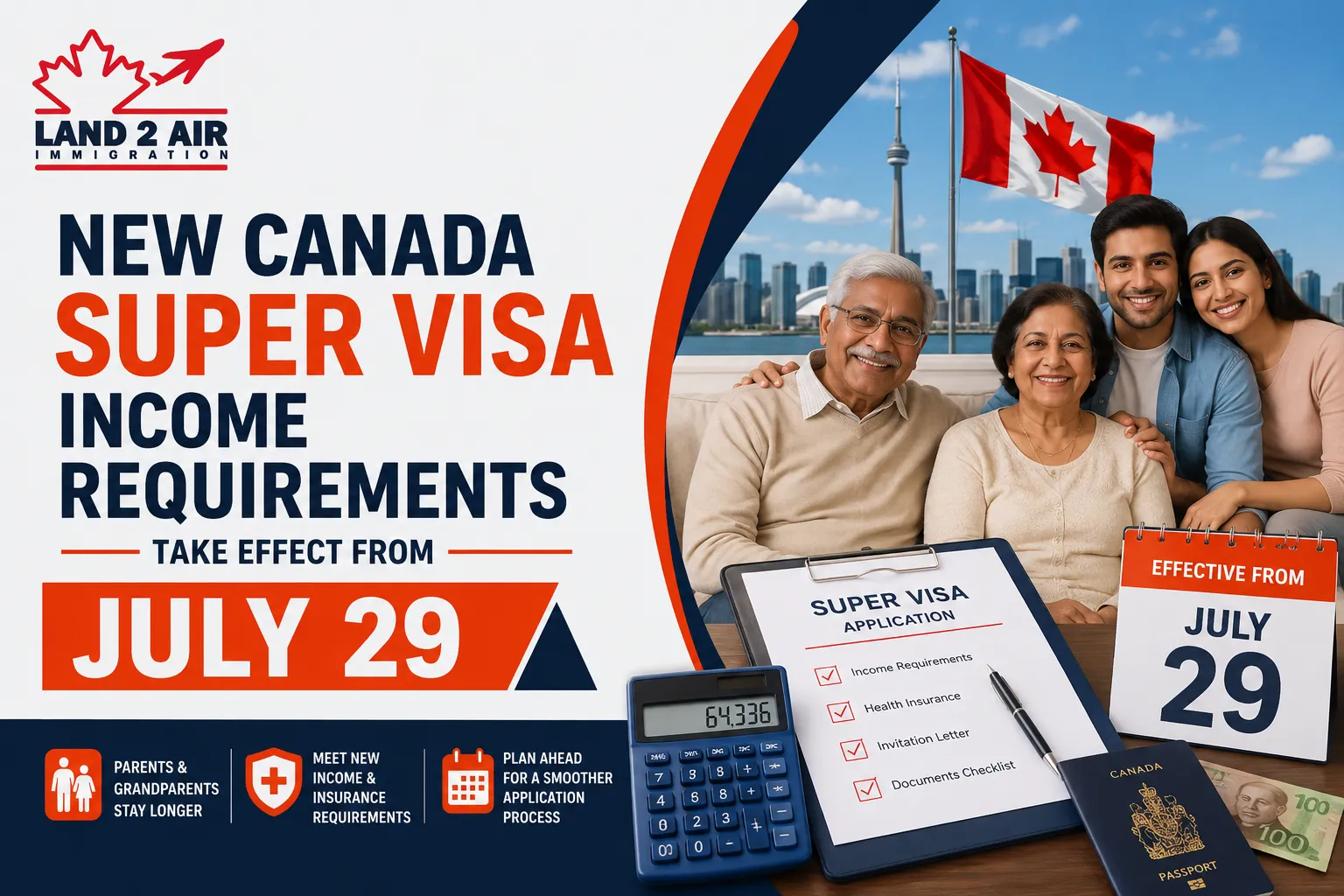
The Canadian Super Visa has remained a valuable option for Canadian citizens or permanent residents whose parents and grandparents wish to stay with their children or grandchildren in Canada for an extended period.
In 2025, Immigration, Refugees and Citizenship Canada (IRCC) announced revised minimum gross income thresholds, representing an increase of 3.9% compared to 2024.
The Super Visa has become even more important as IRCC began issuing more than 17,000 invitations for permanent residence under the Parents and Grandparents Program (PGP) on July 28.
For individuals who are unable to participate in the PGP in 2025, or whose Interest to Sponsor form was not submitted in 2020, the Super Visa remains one of the best available options.
This guide explains the Super Visa, including the eligibility criteria, insurance requirements, application process, and other important points that can help improve your chances of approval.
Whether you are applying for a Super Visa or hosting your parents or grandparents in Canada, understanding the complete process can make your application much easier.
Learn more about the Super Visa: https://land2air.ca/super-visa/
What Is the Canada Super Visa?
The Canada Super Visa is a multiple-entry visa designed specifically for the parents and grandparents of Canadian citizens and permanent residents.
Unlike a regular Visitor Visa, which generally allows a stay of up to six months before an extension is required, the Super Visa allows eligible parents and grandparents to stay in Canada for up to five years without renewing their status.
You can also compare the Visitor Visa vs Super Visa here: https://land2air.ca/visitor-visa-vs-super-visa-for-parents-know-whats-better-for-you/
In addition, Super Visa holders may extend their stay for up to two more years, allowing parents and grandparents to remain in Canada for a total of up to seven years after arrival.
Depending on passport validity, the Super Visa may remain valid for up to ten years, allowing multiple entries into Canada during that period.
The Super Visa is an excellent option for family reunification when permanent residence is not the immediate goal.
However, not every Canadian citizen or permanent resident automatically qualifies to sponsor their parents or grandparents.
Applicants and hosts must meet the required minimum income threshold, satisfy the eligibility requirements, obtain the required health insurance, and demonstrate that the applicant intends to return to their home country after the visit.
If you are unsure whether a Visitor Visa or Super Visa is appropriate, you can also read: https://land2air.ca/visitor-visa/
New Canada Super Visa Minimum Income Requirements for 2025
One of the most significant updates for 2025 is the increase in the minimum gross income requirement for hosts.
These income requirements help ensure that hosts are financially capable of supporting their parents or grandparents during their stay in Canada.
The 2025 income thresholds reflect economic adjustments and inflation and are 3.9% higher than the 2024 requirements.
Below is the comparison of the 2025 and 2024 minimum gross income requirements based on family size.
| Number of Family Members | 2025 Minimum Gross Income | 2024 Minimum Gross Income | % Change |
|---|---|---|---|
| 1 | $30,526 | $29,380 | 3.90% |
| 2 | $38,002 | $36,576 | 3.90% |
| 3 | $46,720 | $44,966 | 3.90% |
| 4 | $56,724 | $54,594 | 3.90% |
| 5 | $64,336 | $61,920 | 3.90% |
| 6 | $72,560 | $69,834 | 3.90% |
| 7 | $80,784 | $77,750 | 3.90% |
| Each additional family member | $8,224 | $7,916 | 3.89% |
How to Calculate Family Size for a Super Visa
To determine whether a host meets the minimum income requirement, the family size must include:
- The Super Visa applicant(s) (parent or grandparent).
- The host (child or grandchild living in Canada).
- The host’s spouse or common-law partner, if applicable.
- Dependent children of the host and their spouse or common-law partner, regardless of custody arrangements.
- Previously approved Super Visa holders sponsored by the same host or their spouse/common-law partner, if their Super Visa remains valid.
- Individuals previously sponsored by the host or their spouse/common-law partner where the sponsorship undertaking is still in effect.
For example, if a Canadian citizen is inviting both their mother and father (two Super Visa applicants), and the host has a spouse and one dependent child, the total family size is five.
In this case, the host must demonstrate a minimum gross income of $64,336 in 2025.
Before submitting your application, you can also review the Visa Checklist: https://land2air.ca/visa-check-list/
Eligibility Criteria for the Super Visa
To qualify for a Super Visa, both the applicant and the host must meet specific eligibility requirements.
Below is a breakdown of the eligibility criteria for both parties.
Host Eligibility
The host (the child or grandchild) must:
- Be a Canadian citizen, permanent resident, or a registered Indian under the Indian Act.
- Be at least 18 years of age and reside in Canada.
- Meet or exceed the minimum necessary income for their family size.
- Provide a letter of invitation that includes:
- A promise to financially support the applicant for the duration of the visit.
- A list of all family members included in the income calculation, including their names and dates of birth.
The host must also submit proof of their status in Canada, such as:
- A Canadian citizenship document (for example, a passport or citizenship certificate).
- A permanent resident document (for example, a PR card).
- A Secure Certificate of Indian Status or Certificate of Indian Status.
The host’s spouse or common-law partner may co-sign the letter of invitation to combine incomes, provided they are also a Canadian citizen or permanent resident.
If you need more information, you can also read:
How to Apply for the Super Visa
https://land2air.ca/how-to-apply-for-the-super-visa/
Applicant Eligibility
Super Visa applicants must:
- Be the parent or grandparent of the host.
- Apply from outside Canada and have their visa printed by a visa office outside Canada.
- Be admissible to Canada, meaning they must not have a criminal record or health issues that pose a risk to public safety.
- Complete an immigration medical examination with an IRCC-approved panel physician.
- Provide proof of a valid health insurance policy.
- Demonstrate strong ties to their home country to show they will leave Canada at the end of their authorized stay.
- Not include dependants (such as children or grandchildren) in the application.
Applicants who are unsure whether a Visitor Visa or Super Visa is suitable for their situation can also read:
Difference Between Canada Visitor Visa & Tourist Visa: A Comprehensive Guide
https://land2air.ca/difference-between-canada-visitor-visa-tourist-visa-a-comprehensive-guide/
Super Visa Insurance Requirements
One of the mandatory requirements for a Super Visa is proof of private health insurance from either:
- A Canadian insurance company, or
- A foreign insurance company authorized by OSFI to provide health insurance in Canada.
The policy must:
- Be valid for at least one year from the date of entry.
- Be paid in full or have a deposit with instalments (insurance quotations are not accepted).
- Cover healthcare, hospitalization, and repatriation.
- Provide a minimum coverage of $100,000.
- Include a statement (for foreign insurers) confirming that the policy was issued as part of their insurance business.
Applicants must maintain valid health insurance throughout their stay in Canada.
If the policy expires before departure, it must be renewed.
Border services officers may request proof of health insurance when the applicant arrives in Canada.
Other Considerations for the Super Visa
IRCC evaluates several factors to determine whether applicants are genuine temporary visitors who will leave Canada voluntarily at the end of their authorized stay.
These factors include:
Ties to the Home Country
Strong ties, such as employment, property ownership, or family, help demonstrate the intention to return.
Purpose of Visit
The primary purpose of the visit should be to spend time with family, not to work or study.
Financial Stability
Applicants should demonstrate that they are financially stable in their home country.
Economic and Political Stability
The economic and political conditions of the applicant’s home country may also be considered when assessing the likelihood of their return.
For additional guidance, you can also review:
Who Can Sponsor Me for a Visitor Visa in Canada and What Is the Process?
https://land2air.ca/who-can-sponsor-me-for-a-visitor-visa-in-canada-and-what-is-the-process/
How Much Bank Balance Should I Require for a Visitor Visa to Canada?
https://land2air.ca/how-much-bank-balance-should-i-require-for-a-visitor-visa-to-canada/